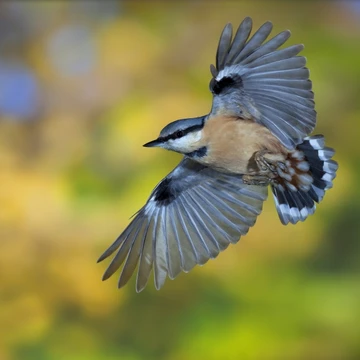
Auk
Auks are Northern Hemisphere seabirds that swim and dive like penguins.

Auks are birds of the family Alcidae in the order Charadriiformes, found throughout the Northern Hemisphere. The family includes murres, guillemots, auklets, puffins, and murrelets, with 22–24 extant species (depending on taxonomy) classified into 11 genera, plus the recently extinct great auk. Apart from the extinct great auk, all auks can fly and are excellent swimmers and divers, though their walking appears clumsy.
- Extant species
- 22–24
Lore & Background
Auks are superficially similar to penguins, with black-and-white colours, upright posture, and some habits, but they are not closely related; this is considered moderate convergent evolution. They are monomorphic, with males and females similar in appearance. Extant auks range from the least auklet at 85 g and 15 cm to the thick-billed murre at 1 kg and 45 cm. Due to their short wings, auks flap very quickly to fly, and their wings are a compromise between diving efficiency and the minimum needed for flight. The Uria guillemots and murrelets are most efficient underwater, while puffins and auklets are better adapted for flying and walking.
Reader's Guide
Auks are significant as a seabird family that exemplifies convergent evolution with penguins, yet they retain flight and occupy a distinct ecological niche in cooler northern waters. Their feeding behaviour as wing-propelled pursuit divers is compared to penguins, and they compete with cormorants in their range. Auks are pelagic, spending most of their lives at sea and going ashore only to breed. They are monogamous, typically lay a single egg, and use nesting sites year after year. Some species nest in large colonies on cliffs, others in small groups on rocky coasts, and puffins, auklets, and some murrelets nest in burrows. Historically, auks were considered an early charadriiform lineage, but genetic analyses show their peculiarities result from strong natural selection from a wading shorebird ancestor. Their closest living relatives appear to be skuas, with separation about 30 million years ago. The earliest unequivocal fossils are from the late Eocene, about 35 million years ago. Most extant genera are known from the late Miocene or early Pliocene, about 5 million years ago. The family's limited geographic range and glacial cycles have shaped its diversity, with more species in the Pacific than the Atlantic.
Did You Know?
- The word 'auk' is derived from Icelandic álka and Norwegian alka or alke, from Old Norse ālka.
- Auks are monomorphic, meaning males and females are similar in appearance.
- The thick-billed murre can weigh up to 1 kg and reach 45 cm in length.
- The flightless subfamily Mancallinae, sometimes included in Alcidae, had fossils found only on the Pacific Coast of southern North America, and became extinct.
Frequently Asked Questions
What is an auk?
Auks are a family of Northern Hemisphere seabirds (Alcidae) within the order Charadriiformes, making them relatives of gulls and terns rather than penguins. The group encompasses familiar species such as puffins, murres, auklets, and murrelets.
Can auks fly?
Yes—every living auk species is a capable flier, even though their short, rigid wings make them look clumsy on land. Their true talent is underwater, where they power through the water as efficient swimmers and deep divers.
How many species of auk are there?
Taxonomists currently recognize roughly 22 to 24 extant species distributed across 11 genera. The exact count shifts slightly depending on whether certain lineages are treated as separate species or subspecies.
What is the great auk?
The great auk (Pinguinus impennis) was a large, flightless auk that went extinct in the 1840s after centuries of human hunting. It is the only auk that ever lost the power of flight, which is why people often mistake it for a penguin.
Why do auks look so similar to penguins?
The resemblance is a product of convergent evolution: both groups independently evolved streamlined bodies and flipper-like wings for efficient underwater hunting. Unlike penguins, however, auks are restricted to the Northern Hemisphere and, apart from the extinct great auk, all retain the ability to fly.
More in Birds 1-24
Elsewhere in the Birds universe
Spotted an error? Know more?
This is a living reference — every entry is fact-audited, and reader corrections feed straight into our audit queue. Suggest an edit · See this site's audit record