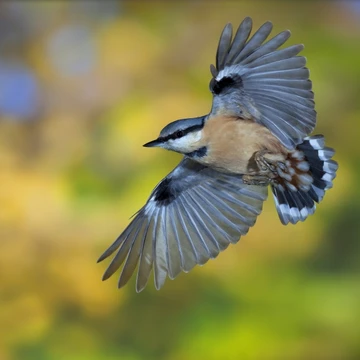
Bird-of-paradise
A family of passerine birds known for elaborate male plumage.

The birds-of-paradise are members of the family Paradisaeidae of the order Passeriformes, found mainly in New Guinea, as well as eastern Australia and the Maluku Islands. The family has 44 species in 17 genera. They are perhaps best known for the plumage of the males, the majority of which are sexually dimorphic, with very long, elaborate feathers extending from the beak, wings, tail, or head. For the most part, they are confined to dense rainforest habitats. Their diet is dominated by fruit and to a lesser extent arthropods. They have a variety of breeding systems, ranging from monogamy to lek-type polygamy.
- Family
- Paradisaeidae
- Order
- Passeriformes
- Number of species
- 44
- Number of genera
- 17
- Primary region
- New Guinea, eastern Australia, Maluku Islands
- Known for
- Elaborate male plumage and sexual dimorphism
Lore & Background
For many years they were treated as closely related to bowerbirds, but today both are considered part of the Australasian lineage Corvida, though only distantly related. Their closest relatives are the crow and jay family Corvidae, the monarch flycatchers Monarchidae, and the Australian mudnesters Struthideidae. The exact limits of the family have been revised. The three species of satinbird were once treated as a subfamily but were moved to a separate family closer to the berrypeckers and longbills in a 2000 study. The same study found that Macgregor's bird-of-paradise was actually a member of the Australasian honeyeater family. The two species of melampitta have been linked with birds-of-paradise but their relationships remain uncertain, more recently linked with the Australian mudnesters. The silktail of Fiji has been linked many times but never formally assigned to the family; recent molecular evidence places it with the fantails. Hybrid birds-of-paradise may occur when individuals of different species, that look similar and have overlapping ranges, confuse each other and crossbreed. Erwin Stresemann examined many controversial specimens during the 1920s and 1930s, proposing that many described species were actually hybrids. Many of those species are now generally considered hybrids, though some are still disputed.
Reader's Guide
The birds-of-paradise are significant as a striking example of sexual selection and plumage evolution. Their elaborate male feathers, used in courtship displays, have made them iconic in ornithology and cultural symbolism. The long tail feather of the Greater bird-of-paradise was used as a decorative element in the Shripech, the royal crown of Nepalese monarchs. Their diversity in breeding systems, from monogamy to lek-type polygamy, provides insight into evolutionary biology. The family's phylogenetic relationships have been clarified by molecular studies, showing their closest relatives are corvids, monarch flycatchers, and Australian mudnesters. Their diet, dominated by fruit, makes them important seed dispersers for New Guinea forests. A number of species are threatened by hunting and habitat loss, highlighting conservation concerns. The study of hybrids has also been important in understanding species boundaries within the family.
Did You Know?
- The long tail feather of the Greater bird-of-paradise was used as a decorative element in the Shripech, the royal crown of Nepalese monarchs.
- The three species of satinbird were once treated as a subfamily of birds-of-paradise but were moved to a separate family in 2000.
- Hybrid birds-of-paradise may occur when individuals of different species with overlapping ranges confuse each other and crossbreed.
Frequently Asked Questions
What is a bird-of-paradise?
Birds-of-paradise are a group of passerine birds in the family Paradisaeidae, most celebrated for the spectacularly ornate feather displays worn by adult males. They are one of the most visually striking bird families on Earth.
Where do birds-of-paradise live?
These birds are found almost exclusively in the dense rainforests of New Guinea, along with parts of eastern Australia and the Maluku Islands. Their preference for thick, humid canopy habitat sets them apart from many other tropical bird groups.
How many species of birds-of-paradise are there?
The family Paradisaeidae contains 44 recognized species spread across 17 genera, making it a moderately large but highly specialized avian family. Each species tends to occupy a specific ecological niche within its rainforest range.
Why do male birds-of-paradise have such elaborate plumage?
The dramatic feather extensions on males are a product of strong sexual dimorphism, driven by female mate choice. These elongated plumes emerge from the beak, wings, tail, or head and are used in courtship rituals to attract a partner.
What do birds-of-paradise eat?
Their diet is primarily fruit-based, supplemented by insects and other small arthropods. This frugivorous-insectivorous mix supports their role as seed dispersers and insect controllers within rainforest ecosystems.
More in Birds 1-24
Elsewhere in the Birds universe
Spotted an error? Know more?
This is a living reference — every entry is fact-audited, and reader corrections feed straight into our audit queue. Suggest an edit · See this site's audit record