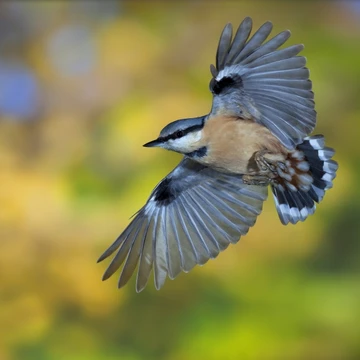
Bird
Warm-blooded, feathered vertebrates that are the only living dinosaurs.

Birds are a group of warm-blooded vertebrate animals constituting the class Aves, characterized by feathers, toothless beaked jaws, the laying of hard-shelled eggs, a high metabolic rate, a four-chambered heart, and a strong yet lightweight skeleton that retains dinosaur-like characteristics. They live worldwide and range in size from the 5.5 cm bee hummingbird to the 2.8 m common ostrich, with over 11,000 living species split into 44 orders. Birds are the only extant members of Dinosauria and are a type of paravian theropod, having evolved from earlier theropods during the Late Jurassic.
- class
- Aves
- number_of_species
- over 11,000 living species
- orders
- 44
- size_range
- 5.5 cm (bee hummingbird) to 2.8 m (common ostrich)
- key_characteristics
- feathers, toothless beaked jaws, hard-shelled eggs, four-chambered heart, lightweight skeleton
- closest_living_relatives
- crocodilians (archosaurs)
- study
- ornithology
Lore & Background
Birds evolved from earlier theropod dinosaurs, with the primitive avialans (including Archaeopteryx) first appearing during the Late Jurassic. Modern birds (Neornithes) likely evolved in the Late Cretaceous and diversified dramatically around the time of the Cretaceous–Paleogene extinction event 66 million years ago, which killed off pterosaurs and all non-ornithuran dinosaurs. The first classification of birds was developed by Francis Willughby and John Ray in their 1676 volume Ornithologiae, later modified by Carl Linnaeus in 1758 to devise the taxonomic classification system currently in use.
Reader's Guide
Birds are significant as the only living representatives of Dinosauria, providing a direct link to theropod dinosaurs. Their unique adaptations—feathers, flight, high metabolic rate, and specialized respiratory and digestive systems—have allowed them to occupy diverse ecological niches worldwide. Over 11,000 species exist, with more than half being passerine or perching birds. Birds are economically important as sources of food (eggs, meat), raw materials (feathers), and guano fertilizer; many species are kept as pets. Human activity has caused the extinction of about 120 to 130 species since the 17th century, and hundreds more before then, with approximately 1,200 species currently threatened. Recreational birdwatching is a key part of ecotourism. In modern cladistic classification, birds are considered reptiles, with their closest living relatives being crocodilians, both forming the clade Archosauria. The definition of Aves remains debated, with some researchers restricting it to the crown group of modern birds (Neornithes), excluding Archaeopteryx, while others use broader definitions.
Did You Know?
- Birds are the only extant members of Dinosauria and are a type of paravian theropod.
- The only known groups without wings are the extinct moa and elephant birds.
- More than half of the world's bird species are passerine or 'perching' birds.
- The closest living relatives of birds are crocodilians, both forming the clade Archosauria.
Frequently Asked Questions
What are birds?
Birds are warm-blooded vertebrate animals in the class Aves, set apart by their feathers, beaked jaws without teeth, and the laying of hard-shelled eggs. They are the only surviving members of the dinosaur lineage, having descended from theropod ancestors during the Late Jurassic.
How many bird species exist and how are they grouped?
More than 11,000 living bird species are spread across 44 distinct orders. These species inhabit every continent and virtually every terrestrial and marine habitat on the planet.
What physical traits define a bird?
Birds are identified by their feathered bodies, toothless beaked jaws, four-chambered hearts, high metabolic rates, and lightweight yet strong skeletons that retain structural features inherited from their dinosaur ancestors. They also reproduce exclusively by laying hard-shelled eggs.
Are birds actually dinosaurs?
Yes—birds are the only extant members of the clade Dinosauria, making them a living type of paravian theropod. They evolved from earlier theropod dinosaurs in the Late Jurassic, so every bird alive today is technically a surviving dinosaur.
What is the size range of birds?
Birds span an enormous size spectrum, from the 5.5-centimeter bee hummingbird to the 2.8-meter-tall common ostrich. Despite this variation, all species share the same fundamental anatomical blueprint.
More in Birds 1-24
Elsewhere in the Birds universe
Spotted an error? Know more?
This is a living reference — every entry is fact-audited, and reader corrections feed straight into our audit queue. Suggest an edit · See this site's audit record