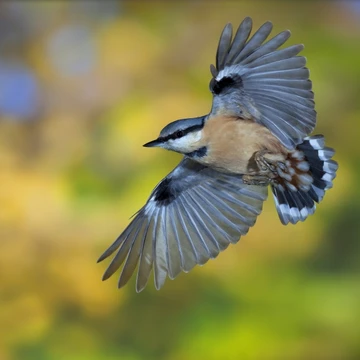
Falcon
Fast-flying raptors with exceptional vision and a global distribution.
Falcons make up the genus *Falco*, a group of about 40 species of birds of prey. You’ll find them on every continent except Antarctica, though fossil evidence shows that similar raptors lived there during the Eocene. Their trademark is a set of thin, tapered wings built for blistering speed and sharp turns. Unlike hawks and eagles—which belong to a different family and kill with their feet—falcons dispatch their prey using a special notch on their beak called a tomial “tooth.”
Young falcons, in their first year of flight, have longer flight feathers that give them a more general-purpose wing shape, like a broadwing. This helps them learn the aerial skills they’ll need as adults without being as specialized. The largest falcon is the gyrfalcon, reaching up to 65 cm (26 in) in length; the smallest is the pygmy falcon, at just 20 cm (7.9 in). Like many raptors, females are typically larger than males—a trait called sexual dimorphism—which lets the pair hunt a wider range of prey.
Falcons have exceptional vision; one species’ eyesight is 2.6 times sharper than a human’s. They’re also incredibly fast fliers. Peregrine falcons have been recorded diving at 320 km/h (200 mph), and the fastest measured dive hit 390 km/h (240 mph), making them the fastest-moving animals on Earth.
The genus *Falco* was first described by Carl Linnaeus in 1758, with the merlin as the type species. The name comes from Late Latin *falco*, derived from *falx* (“sickle”), a reference to the bird’s claws. A male falcon is called a tercel or tiercel—from the Latin *tertius* (“third”), based on the old belief that only one in three eggs produced a male, or because males are about a third smaller than females. A downy chick, especially one raised for falconry, is an eyas (from a misdivision of Old French *un niais*, meaning “nestling”). The practice of hunting with trained falcons is falconry.
The fossil record for falcons is patchy. For years, the oldest fossils assigned to the genus were from the Late Miocene, less than 10 million years ago. But as of 2021, the oldest known falconid fossil dates back about 55 million years. Based on where living and fossil *Falco* species are found, falcons likely originated in North America, Africa, or possibly the Middle East or Europe. They aren’t closely related to other birds of prey; they belong to the group Australaves, whose nearest relatives are parrots and songbirds.
Falcons can be roughly split into three or four groups. The first includes kestrels—small, stocky birds with brown upperparts, often showing sexual dimorphism. Three African species are gray instead. Kestrels mostly eat terrestrial vertebrates and large invertebrates like rodents, reptiles, and insects. The second group is the hobbies and their relatives, which are slightly larger, have dark slate-gray plumage, and nearly always a black patch on the cheek (the malar area). They mainly hunt smaller birds. The third group includes the peregrine falcon and its kin—powerful, fast birds with black malar areas (except in some pale color morphs) and often a black cap. They’re medium gray above, with horizontal barring below, and their tails are uniformly dark gray with faint black bands and small white tips. These large falcons feed on mid-sized birds and terrestrial vertebrates. Very similar are the hierofalcons (or “hawk-falcons”), which have more reddish or brown colors and a hawk-like pattern of blotches or arrowhead marks on their undersides.
- Scientific name
- Falco
- Number of species
- About 40
- Largest species
- Gyrfalcon, up to 65 cm (26 in) in length
- Smallest species
- Pygmy falcon, 20 cm (7.9 in)
- Visual acuity
- Up to 2.6 times that of human eyes
- Sexual dimorphism
- Females typically larger than males
Lore & Background
The genus Falco was introduced in 1758 by Carl Linnaeus in the tenth edition of his Systema Naturae, with the type species being the merlin (Falco columbarius). The name Falco is Late Latin meaning 'falcon,' from falx, falcis, meaning 'a sickle,' referring to the claws. In Middle English and Old French, faucon referred generically to several captive raptor species. The traditional term for a male falcon is tercel or tiercel, from Latin tertius (third), due to the belief that only one in three eggs hatched a male, or because a male is about one-third smaller than a female. A falcon chick reared for falconry, still in its downy stage, is called an eyas, from mistaken division of Old French un niais.
Reader's Guide
Falcons are significant as the largest genus in the Falconinae subfamily of Falconidae, which also includes caracaras and a few other species. They are not closely related to other birds of prey, being part of the class Australaves, with their nearest relatives being parrots and songbirds. The fossil record of falcons is not well distributed in time; the oldest falconid fossil is estimated to be 55 million years old, and falcons are probably of North American, African, or possibly Middle Eastern or European origin. They are roughly divisible into three or four groups: kestrels, hobbies and relatives, peregrine falcons and their relatives, and hierofalcons. These groups are an informal arrangement but likely contain several distinct clades. The technique of hunting with trained captive falcons is known as falconry.
Did You Know?
- Fledgling falcons have longer flight feathers that make their wing configuration more like a general-purpose bird, aiding learning.
- Falcons kill prey with their beaks using a tomial 'tooth,' unlike hawks and eagles that use talons.
- The genus name Falco derives from Late Latin meaning 'falcon,' from falx, falcis, meaning 'a sickle,' referring to the claws.
Frequently Asked Questions
What is a falcon?
Falcons are a group of roughly 40 bird-of-prey species belonging to the genus Falco. They are recognized by their narrow, pointed wings that are built for high-speed flight and quick directional shifts.
How do falcons differ from hawks and eagles?
Unlike hawks and eagles, which primarily subdue prey with their talons, falcons rely on their beaks and a specialized cutting edge called a tomial tooth to kill. This anatomical distinction is one of the clearest ways to separate falcons from other raptors.
What are the size extremes among falcon species?
The Gyrfalcon is the largest, reaching up to 65 centimeters (about 26 inches) in length, while the Pygmy falcon is the smallest at roughly 20 centimeters (about 8 inches). Across the genus, females are generally larger than their male counterparts.
How sharp is a falcon's vision?
A falcon's visual acuity can be up to 2.6 times better than that of a human eye. This extraordinary sight lets them spot and track small prey at high speed and from great distances.
Where are falcons found in the wild?
Falcons inhabit every continent except Antarctica, making them one of the most widely distributed raptor groups on Earth. That said, closely related raptors did live in Antarctica during the Eocene epoch, so the region isn't entirely without a historical connection.
More in Birds 1-24
Spotted an error? Know more?
This is a living reference — every entry is fact-audited, and reader corrections feed straight into our audit queue. Suggest an edit · See this site's audit record