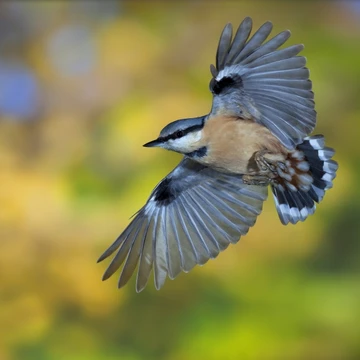
Finch
Small to medium-sized passerines with stout conical bills.
The true finches, belonging to the family Fringillidae, are small to medium-sized songbirds. They are equipped with stout, conical beaks well-suited for cracking seeds and nuts, and many species display vibrant plumage. These birds are generally non-migratory residents across a wide variety of habitats. While they have a nearly global native range, they are absent from Australia and the polar regions. This family is large, containing over two hundred species across fifty genera, including canaries, siskins, redpolls, serins, grosbeaks, euphonias, and the Hawaiian honeycreepers, which are morphologically distinct.
Many other birds not in this family are also commonly called finches. These include the estrildid finches of the Old World tropics and Australia, some members of the bunting and New World sparrow families, and the famous Darwin's finches of the Galapagos, which are now classified as tanagers. Historically, finches and canaries were used in coal mines in the UK, US, and Canada to detect carbon monoxide, a practice that ended in the UK in 1986.
The finch family name, Fringillidae, was introduced in 1819 by zoologist William Elford Leach. The taxonomy, especially of the cardueline finches, has been complex and debated, complicated by similar body shapes evolving in species that occupy similar ecological roles. Starting around 1990, DNA studies led to major revisions. For instance, the Neotropical Euphonia and Chlorophonia, once placed with tanagers, are now in their own finch subfamily, Euphoniinae. The Hawaiian honeycreepers, formerly in their own family, are now placed within the Carduelinae subfamily, close to the rosefinches. Large genera like *Carpodacus*, *Carduelis*, and *Serinus* were found to be polyphyletic and were split into separate, monophyletic genera. Today, the family is divided into three subfamilies: Fringillinae (with just the chaffinches), Carduelinae (with 183 species in 49 genera), and Euphoniinae. One bird, Przewalski's "rosefinch," which has ten primary flight feathers instead of the usual nine, is now placed in its own distinct family, Urocynchramidae.
Fossil remains of true finches are scarce, and most can be assigned to living genera. The family likely originated in the Middle Miocene, roughly 20 to 10 million years ago. One unidentifiable finch fossil from the Late Miocene has been found in Hungary.
In terms of size, the smallest true finches include the Andean siskin and the lesser goldfinch, while the largest is probably the collared grosbeak, though the pine grosbeak and evening grosbeak can reach slightly greater lengths or weights. Their beaks are typically strong and stubby, though Hawaiian honeycreepers show an extreme variety of bill shapes due to adaptive radiation. All true finches have nine primary flight feathers and twelve tail feathers. Basic plumage is brownish or greenish, often with black; white is usually limited to wing bars. Bright yellow and red carotenoid pigments are common, while blue colors are rare because yellow pigments turn blue to green. Many species show strong sexual dichromatism, with females lacking the males' bright colors.
Finches are found across the Americas, Eurasia, Africa, and some island groups like Hawaii. They are absent from Australasia, Antarctica, the Southern Pacific, and most Indian Ocean islands, though some European species have been introduced to Australia and New Zealand. They typically inhabit well-wooded areas.
- family
- Fringillidae
- species_count
- over 200 species divided into 50 genera
- subfamilies
- Fringillinae, Carduelinae, Euphoniinae
- smallest_species
- Andean siskin (Spinus spinescens) at 9.5 cm; lesser goldfinch (Spinus psaltria) at 8 g
- largest_species
- collared grosbeak (Mycerobas affinis) up to 24 cm and 83 g
- native_range
- Americas, Eurasia, Africa, and some island groups including Hawaiian islands
- notable_use
- used in coal mining to detect carbon monoxide from 18th to 20th century
Lore & Background
The taxonomy of the family, particularly the cardueline finches, has a long and complicated history, confounded by convergence of similar morphologies. Beginning around 1990, phylogenetic studies based on mitochondrial and nuclear DNA sequences led to substantial revisions: the Neotropical Euphonia and Chlorophonia were moved from the tanager family to a separate subfamily Euphoniinae within Fringillidae, and the Hawaiian honeycreepers were found to be closely related to Carpodacus rosefinches and placed within Carduelinae.
Reader's Guide
The true finches are significant as a widespread and diverse family of seed-eating birds that have adapted to a variety of habitats across the Americas, Eurasia, and Africa. Their taxonomy has been a subject of extensive study and revision, particularly due to convergent evolution that obscured relationships. The inclusion of the Hawaiian honeycreepers, which underwent adaptive radiation producing a wide range of bill shapes, highlights the family's evolutionary importance. Finches also have a notable historical role: they were used in the UK, US, and Canada in the coal mining industry to detect carbon monoxide from the eighteenth to twentieth century, a practice that ceased in the UK in 1986. The family's many species, including canaries, siskins, and grosbeaks, are well-known to ornithologists and bird enthusiasts, and their study has contributed to understanding of speciation and biogeography.
Did You Know?
- Finches were used in coal mining to detect carbon monoxide from the 18th to 20th century; the practice ceased in the UK in 1986.
- The smallest true finch is the Andean siskin at 9.5 cm; the largest is the collared grosbeak at up to 24 cm.
- Hawaiian honeycreepers are now placed within the finch family, having been found closely related to Carpodacus rosefinches.
- The family Fringillidae contains over 200 species divided into 50 genera and three subfamilies.
Frequently Asked Questions
What is a finch?
Finches are a diverse group of small to medium-sized songbirds in the family Fringillidae, recognized for their thick, cone-shaped beaks and often vivid feather colors. The group encompasses well-known birds like canaries, siskins, redpolls, and grosbeaks, as well as the strikingly different Hawaiian honeycreepers.
How big do finches get?
They range from the tiny Andean siskin at just under 10 centimeters to the collared grosbeak, which can reach about 24 centimeters and weigh up to 83 grams. Over 200 species are spread across roughly 50 genera within the family.
Where do finches live?
Finches are native to the Americas, Eurasia, Africa, and various island groups such as the Hawaiian archipelago, but they are absent from Australia and the polar regions. Most species tend to stay in one area year-round rather than undertaking long migrations.
What do finches eat?
Their sturdy, conical beaks are specifically shaped for cracking open seeds and nuts, which form the bulk of their diet. This seed-eating adaptation is a defining trait that sets them apart from many other passerine families.
How many finch species are there?
There are more than 200 recognized species organized into 50 genera, divided across three subfamilies: Fringillinae, Carduelinae, and Euphoniinae. This makes Fringillidae one of the more species-rich families among passerine birds.
More in Birds 1-24
Spotted an error? Know more?
This is a living reference — every entry is fact-audited, and reader corrections feed straight into our audit queue. Suggest an edit · See this site's audit record